
Should a 19-Year-Old Roof Get Roof Replacement in Plano, TX Before the Insurance Renewal?
The situations described here are composites drawn from the types of jobs and decisions we encounter regularly. Names and specific figures are illustrative.
A one-story brick house in east Plano had a 19-year-old roof of 3-tab asphalt shingles that had never leaked. In September, the owner’s homeowners insurance renewal said the roof would now be covered at actual cash value instead of replacement cost. The decision was whether to keep the roof and live with that change, or pay for roof replacement in Plano, TX this fall and go back to the insurer with a new roof. The number that settled most of it came from the Texas Department of Insurance: in its example of a $10,000 roof with a $4,000 deductible, an actual cash value policy pays $0 on a 20-year-old roof.[1]
That is the whole story in one paragraph. The rest of this post is how the owner got from that renewal letter to a signed contract, what the roof actually looked like up close, and where spending more would have stopped making sense.
What the renewal letter actually changed
Most homeowners policies pay to repair or rebuild based on current costs. That is replacement cost coverage. Actual cash value coverage pays less, because it subtracts depreciation for the age and condition of the roof. Policies with actual cash value coverage cost less, and they also pay less when there is a claim.[1]
The Texas Department of Insurance tells homeowners to check for roof coverage changes at every renewal, because as roofs age, some companies switch to actual cash value. It also says the company should tell you when it changes your coverage.[2] That is what happened here. The change sat in a short paragraph on page three of the renewal packet, and the owner only caught it because the premium went down slightly instead of up.
Here is the department’s own example, which the owner printed and brought to the inspection:
| Roof age (TDI example: $10,000 roof, $4,000 deductible) | Actual cash value of roof | Actual cash value policy pays | Replacement cost policy pays |
|---|---|---|---|
| 5 years | $8,500 | $4,500 | $6,000 |
| 10 years | $7,000 | $3,000 | $6,000 |
| 20 years | $4,000 | $0 | $6,000 |
Source for every figure in that table: the Texas Department of Insurance consumer page on replacement cost and actual cash value.[1] Real numbers on a real policy will differ, since the house value, the deductible and the depreciation schedule all vary. The pattern does not. On a roof near 20 years old, an actual cash value claim can land at or near zero once the deductible comes off.
The worry that turned out to be wrong
The owner’s first fear was not the coverage change. It was a neighbor’s story about an insurer dropping a policy because the roof was “too old.” That fear is out of date for Texas. On September 29, 2026, the Texas Department of Insurance announced it was clarifying its rule that insurance companies cannot decline or not renew a home policy based on the age of the house or its roof. Companies can still make decisions based on the physical condition of the roof and other components.[3]
So age alone was not going to cost this owner the policy. Condition could, though. The department also notes that an insurer will inspect the roof when you apply, may charge more or refuse coverage based on what it sees, and might not cover a roof in poor condition at all.[2] That shifted the question from “will they drop me” to “what shape is this roof actually in.”
What the roof looked like up close
The owner scheduled a free roof inspection, which comes with a photo report and no obligation. From the street, the roof looked fine. Gray shingles, straight lines, nothing missing.
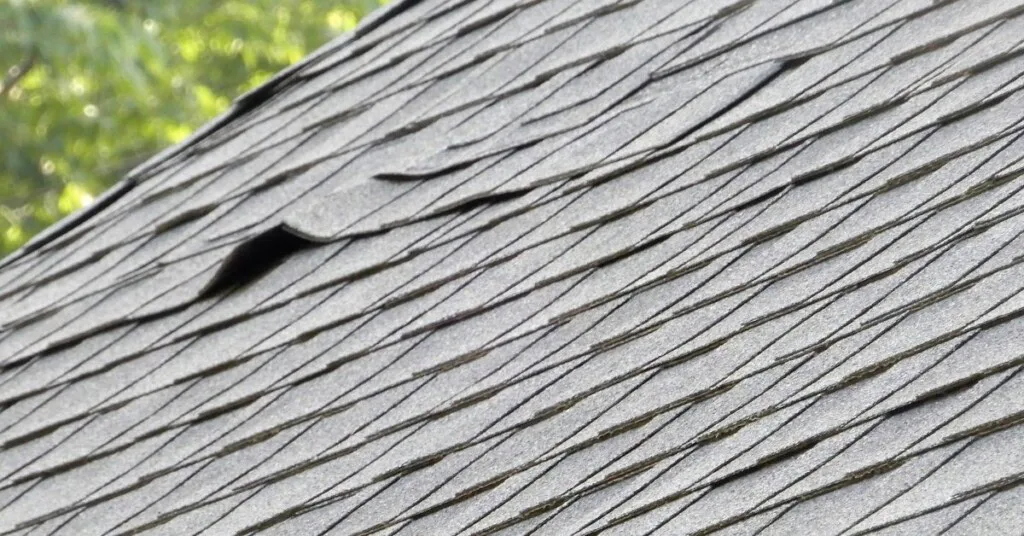
On the roof, it read differently. The west and south slopes, which take the afternoon sun, had lost a good share of their granules, and the shingle mat showed through in spots. About a dozen tabs had lifted and no longer lay flat. Several of them cracked when they were gently raised, which is what brittle 3-tab shingles do late in their life. One plumbing vent boot had a split collar. From the attic, the decking looked dry and there were no stains around the vents or the chimney chase.
For context on age, the International Association of Certified Home Inspectors lists 3-tab asphalt shingles at about 20 years and architectural shingles at about 30. The same chart says hot climates drastically reduce asphalt shingle life, and that roofs in hail country may see a shorter lifespan overall.[4] A 19-year-old 3-tab roof in Plano was right at the edge of that range. The signs on this roof match what we describe in the warning signs that a roof needs replacing: granule loss, lifting tabs, and brittleness, with no active leak yet.
The two options on the table
Nothing on this roof was an emergency. That made the decision harder, not easier. The owner could fix the split boot and reseal the lifted tabs for a few hundred dollars and keep going. Or the owner could replace the roof now, on a schedule of their own choosing, instead of after a storm.
Here is how the two options lined up for this house. The dollar figures are specific to this job and are illustrative:
| Repair and keep the roof | Replace this fall | |
|---|---|---|
| Cost this year | About $450 (boot, reseal lifted tabs) | About $14,800 (tear-off, new architectural shingles, permit) |
| Roof coverage on the policy | Stays at actual cash value | Owner can send proof of the new roof to the agent and ask for a review |
| If hail takes the whole roof | Claim math looks like the 20-year row in the TDI example | Claim math looks like the replacement cost column |
| Who picks the timing | The next storm | The homeowner |
The hail row is the one that mattered. Texas had 902 major hail events with stones an inch or larger in 2025, more than any other state, according to Storm Prediction Center data compiled by the Insurance Information Institute.[5] Collin County homeowners do not need a statistic to know hail comes back. The table just put a number on what an aging roof costs when it does.
“Insurance pays for storm damage. It won’t pay for a new roof just because the old one is worn out.[2] When a 20-year-old roof is on actual cash value, a full-roof claim can pay nothing after the deductible,[1] and a homeowner should see that number before deciding anything.”
Don Scott, Co-Founder, Fireman’s Roofing
That was the decision point. Repair was cheaper this year by a wide margin. But repair also meant carrying a roof the insurer had already priced near zero, with the next storm deciding when the real bill arrived. The owner chose to replace.
Where spending more stopped making sense
The owner asked about going further: metal, a premium designer shingle, new gutters all around. Some of that made sense and some did not. The Texas Department of Insurance notes that roofing materials less likely to be damaged by wind, hail or fire may earn a discount from your insurer.[2] So the owner asked the agent before choosing a shingle, rather than after, and priced an impact-rated option alongside a standard architectural shingle. We walked through a similar choice in a post about an Allen homeowner weighing Class 4 shingles.
Where it stopped making sense was the gutters. They were seamless aluminum, about eight years old, draining well, with no pulled hangers. Replacing them would have added cost with nothing wrong to fix. They came off for the tear-off and went back up.
Why fall, and what the Plano permit added
The timing was the owner’s call. Fall gave room to schedule the work without a storm backlog, and it put the new roof on the house well before the next renewal date. In Plano, a roof permit is required on all re-roof projects, and the city’s final roof inspection checks the attic for vent piping through the roof, confirms the rafters are in position, and verifies that water heater and furnace exhaust vents were reinstalled properly.[6] The city also allows the homeowner to certify that the roofing contractor performed that final inspection instead.[6]
That inspection list lines up with what can go wrong on a tear-off. Exhaust vents get disturbed when the old roof comes off, and a water heater flue that is not reseated correctly is a safety problem, not a cosmetic one. On this job the crew photographed each vent after reinstalling it, and those photos went into the closeout packet with the permit. The full process is laid out on our roof replacement page, and the local details are on the Plano roofing services page.
What people usually ask at this point
The first question is almost always some version of “won’t insurance just pay for it?” Not for age. The Texas Department of Insurance says plainly that your insurance company won’t pay for a new roof just because it’s old or worn out.[2] Insurance responds to covered damage, like a storm or a falling tree.
The second is “can they cancel me because the roof is 20?” Under the rule clarification announced September 29, 2026, not for age alone. Condition still counts.[3]
The third is “should I just wait for hail and get a free roof?” On replacement cost coverage, a covered storm claim pays the cost to replace minus the deductible. On actual cash value with a roof near 20 years old, the TDI example shows that claim paying nothing.[1] Waiting is a bet that the coverage will still be replacement cost when the hail shows up.
And the last one is “do I need a permit in Plano?” Yes, for every re-roof project.[6]
What happened after
The tear-off took one day and the install finished the next morning. Under the old shingles the decking was sound except for one sheet near the split vent boot, which had a soft spot from slow moisture over the years. That one sheet was replaced. It would have kept spreading under a repair-only approach, and nobody would have seen it from the attic until it stained.
The owner sent the agent the final invoice, the permit and the photo report. The roof coverage on the next renewal was reviewed with the new installation date. The premium went up a little with replacement cost restored, and the owner was fine with that trade. The one regret was not catching the coverage change a year earlier, when the roof was 18 and the owner had already read the same renewal paragraph without understanding it.
What this house says about older roofs in Plano
An older roof that does not leak is not automatically a roof that needs replacing. If your policy still covers it at replacement cost and an inspection shows sound shingles, a repair and another year can be a reasonable call. If the renewal has moved it to actual cash value and the shingles are near the end of their range, the math changes, and it is worth running it with your own deductible before a storm runs it for you. For homeowners weighing roof replacement in Plano, TX, the renewal letter is often the first document worth reading closely.
If you want a second look at an aging roof, you can request a free roof inspection here.
Sources
- Home policies: Replacement cost or actual cash value?, Texas Department of Insurance, updated 2024
- Insurance and your roof: What to know when buying a policy or filing a claim, Texas Department of Insurance, updated 2026
- Texas homeowners protected from being denied insurance based on roof age, Texas Department of Insurance news release, September 29, 2026
- International Standard of Practice for Inspecting and Estimating Life Expectancy (component life expectancy chart), International Association of Certified Home Inspectors (InterNACHI)
- Facts + Statistics: Hail, Insurance Information Institute (Triple-I), citing NOAA Storm Prediction Center data, 2026
- Certification of Final Roof Installation, City of Plano Building Inspections Department
