
Does a Downspout Draining Against the Slab Call for Gutter Repair in Little Elm, TX?
The situations described here are composites drawn from the types of jobs and decisions we encounter regularly. Names and specific figures are illustrative.
This is a gutter repair in Little Elm, TX story about a 2006 one-story brick house on a slab, a few streets off Eldorado Parkway on the Little Elm side of the lake. The gutters were original aluminum, about 140 feet in all, with four downspouts. The back-left downspout had no elbow and no extension, so every drop from that side of the roof landed on bare dirt against the slab. In October, after the first few soaking rains following a dry summer, the owners noticed the back bedroom door rubbing at the top and a thin crack in the mortar near that same corner. A neighbor told them to call a foundation company. They called us first because the water was coming off the roof, and they wanted to know whether this was a gutter problem, a foundation problem, or both.
What was actually happening at that corner
The elbow had been clipped by a mower sometime in the spring and never put back. Nobody noticed through the summer because it barely rained. With the elbow gone, the downspout ended about eight inches above the ground and dumped straight down into a flower bed that sat right against the brick. The mulch had washed out, and there was a small hollow in the dirt where the water had been landing.
The rear gutter run feeding that downspout had its own problem. Two hangers in the middle of the 38-foot run had pulled loose, and the gutter had dropped enough that the middle sat lower than the outlet. In a hard rain, water collected in that low spot and spilled over the front lip, landing in a line about a foot from the wall. So that one side of the roof was sending water to the foundation two ways: over the edge of a sagging gutter and straight out of a downspout with nothing on the end.
Water at the foundation matters more here than it does in a lot of the country because of the soil. The Blackland Prairie, which runs from north of Dallas down to San Antonio, is known for Houston Black clay, a soil that shrinks and swells a great deal as its moisture changes, and its shrink-swell potential is a common limitation on building sites[1]. The federal soil description for that series notes that in dry periods it opens cracks from half an inch to four inches wide that reach a foot or more deep[2]. Not every yard in Little Elm sits on that exact soil, but the clay at this house behaved the same way. By the end of summer it had pulled back from the slab along the back wall, leaving a gap you could slide a finger into.
That timing is why fall is when this shows up. The same soil description says water enters the soil rapidly when it is dry and cracked, and very slowly once it is moist[2]. The first heavy rains after a dry summer were running off that corner of the roof and straight down the gap next to the slab, wetting the clay at one corner while the rest of the house sat on drier ground.
Why the door and the crack got their attention
The owners were not wrong to connect the door to the soil. An agricultural engineer with North Dakota State University Extension describes sticking doors and windows, and cracks in walls or ceilings, as possible signs that a building is shifting because the soil under it has shrunk, and notes that a gap between the soil and the wall lets rainwater run straight down along the foundation[3]. That is close to what we saw at this corner.
What we could not do from a ladder was say how much the slab had moved, if at all. We are roofers. We can tell a homeowner where the water from the roof is going and fix that part. Whether a slab needs leveling is a question for a foundation contractor or a structural engineer. What we could say was that no foundation repair was going to hold up well while one downspout kept soaking one corner every time it rained, so the water had to be dealt with first either way.
What the code asks for, and what this corner had
The residential code has a section written for exactly this kind of soil. Where expansive soils are known to exist, the 2021 International Residential Code calls for a controlled way to collect roof water and discharge it at least 5 feet from the foundation walls, or into an approved drainage system[4]. The same code asks for lots to be graded so the ground falls at least 6 inches within the first 10 feet away from the foundation[5]. Here is how the back corner measured up when we looked at it.
| Item | Code reference | Back-left corner |
|---|---|---|
| Where roof water lands | At least 5 feet from the foundation where soils are expansive[4] | 0 feet, no elbow or extension |
| Ground slope away from the house | At least 6 inches of fall in the first 10 feet[5] | About 1 inch of fall, with a low spot at the wall |
| Gutter pitch on the rear run | Should drain toward the outlet | Middle sagging below the outlet, spilling over the front lip |
The house was built in a subdivision that met the rules when it was finished. Twenty years of mulch, edging, flower beds and one missing elbow had changed what was actually happening at that corner. That is the common pattern. The system works on paper and drifts in the yard.
“Where the soil swells and shrinks, the code wants the roof water put down at least five feet from the foundation.[4] A downspout that stops at the slab puts all the water from that side of the roof in the one spot you least want it.”
Don Scott, Co-Founder, Fireman’s Roofing
The three ways it could have gone
The owners had already been given a number for a new gutter system by another company, around $1,900 for seamless 6-inch gutters on the whole house. That would have fixed the sag. It would not have fixed the discharge unless someone also added extensions, and the other three runs were draining fine. Here is how the options lined up.
| Option | What it covers | Rough cost on this job |
|---|---|---|
| Put the elbow back and add a splash block | Moves water a foot or two off the wall. Sagging run still spills. | About $60 |
| Repair the rear run and extend the discharge | Re-hang and re-pitch 38 feet, new elbow, 10-foot extension to the side yard, reseal two seams | About $640 |
| Replace all gutters | New system on 140 feet. Discharge still needs extensions. | About $1,900 plus extensions |
The splash block was the tempting one. It costs almost nothing, and a homeowner can do it in five minutes. The trouble is that a splash block puts water a couple of feet from the wall on a corner where the ground already sloped back toward the house. The water would have run right back to the slab. It would have helped, just not enough.
Full replacement was the other end. The gutters were 20 years old but the metal was sound, the seams on the other three runs were tight, and the fascia behind the sagging section was solid when we pushed on it. Spending three times as much to replace three runs that were working would not have moved any more water away from that corner than the repair did. That was the point where spending more stopped buying anything.
They chose the middle option. If you want to see how we handle this kind of work on other houses, our gutter repair service page walks through what a repair visit usually includes.
How the repair went
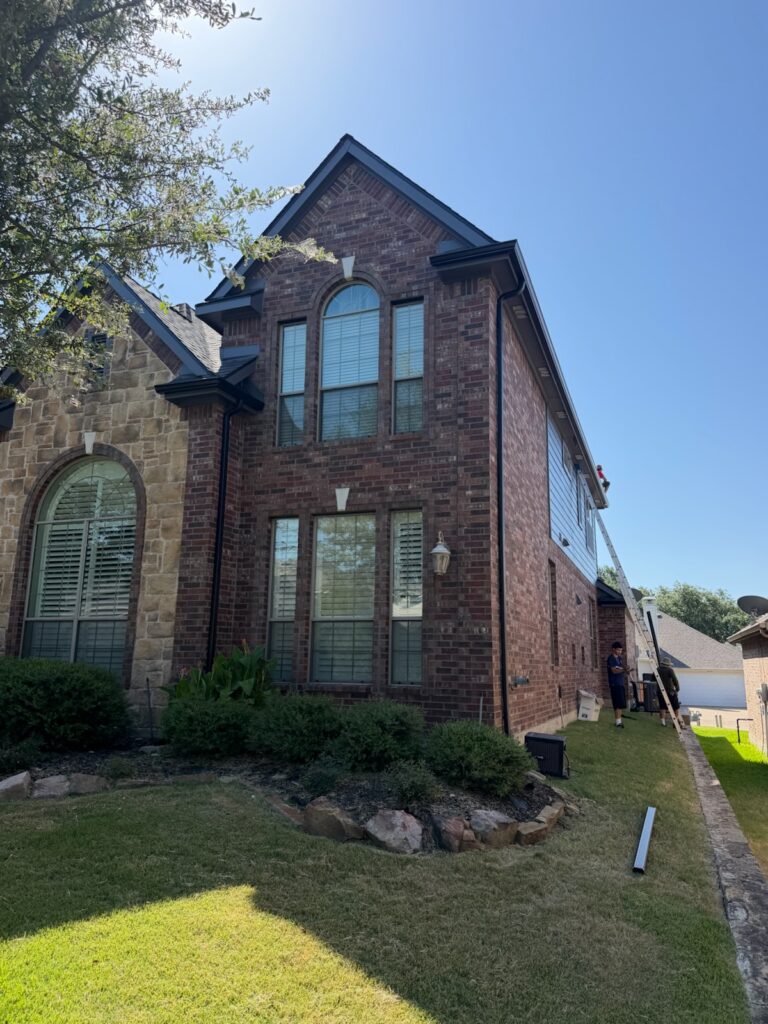
The work took about three hours. We took the two loose hangers out and set new hidden hangers into solid fascia along the whole rear run, then snapped a line so the run fell steadily to the outlet and re-hung the gutter on it. Two corner seams that had hairline gaps got cleaned and resealed. We ran a hose at the far end and watched the water move all the way to the outlet without pooling.
At the bottom, a new elbow went on, then a 10-foot extension carried the water across the side yard to where the ground starts to drop toward the street. That put the discharge well past the 5-foot mark. A buried drain line was an option, and some owners prefer how it looks, but buried lines can clog where you cannot see them. We have written about that before in a Princeton downspout repair where a buried line backed up for a year. For this house, an above-ground extension they could see and move for mowing made more sense.
The grading was the owners’ part. They pulled the bed edging back, filled the hollow at the corner with soil, and built it up so it fell away from the brick, keeping the dirt below the weep holes in the brick. That cost them a weekend and a few bags of soil.
What the owners asked while we were there
The first question was whether they still needed a foundation company. My answer was not yet, probably. A hairline mortar crack and a door that rubs after a wet spell can come from soil moving a little and then settling back. If the crack widens, if new cracks show up inside, or if the door keeps getting worse after the corner has stayed dry for a few weeks, then it is worth paying a foundation professional to look. Fixing the water first means that if they ever do need foundation work, it will not be fighting a downspout.
The second question was about watering the foundation, since a neighbor runs a soaker hose all summer. The NDSU Extension guidance suggests keeping soil moisture fairly even around the whole building in long dry spells, putting the water 1 to 2 feet out from the wall rather than into the gap, and applying it slowly so it soaks in[3]. The idea is even moisture all the way around. A broken downspout does the opposite, flooding one corner while the rest stays dry.
The third was whether they should have bigger gutters. The roof on this house is a simple hip with four downspouts, and three of the four runs had never overflowed. Going to 6-inch gutters makes sense on bigger, steeper roofs with long runs, and our gutter installation page covers when that upgrade earns its cost. On this house the problem was where the water went, not how much the gutter could hold.

A few weeks later
The owners sent photos after the next two rains. The extension was carrying water out to the side yard, the bed by the corner stayed firm, and nothing was spilling over the rear gutter. The bedroom door still rubbed a little for a while, then eased, and the mortar crack had not grown. They put a pencil mark at each end of it so they would know if it ever did.
Nothing about this job was complicated. What made it worth writing about is how often the first call after a sticking door goes to a foundation company when the water source is hanging off the eave. Sometimes the foundation does need work. It is still cheaper to rule out the gutter first, and a free roof and gutter inspection covers both the roof edge and where each downspout lets out.
What to take from it
If your house is on clay and a corner of the yard stays soggy after rain, look at the downspout above it before anything else. If it ends at the slab, or the gutter feeding it spills over the front, that is the cheapest part of the problem to fix and the part that has to be fixed first. If the cracks keep moving after the water is gone, that is a different conversation with a different trade. For anyone weighing gutter repair in Little Elm, TX against a full replacement, the question worth asking is whether the new gutters would change where the water goes. Often they would not.
Sources
- Houston Black: Texas State Soil, USDA Natural Resources Conservation Service (hosted by the Texas Water Development Board)
- Official Soil Series Description: Houston Black Series, USDA Natural Resources Conservation Service
- Dry Soil May Cause Building Problems, North Dakota State University Extension
- 2021 International Residential Code, Section R801.3 Roof Drainage, International Code Council (via UpCodes)
- 2021 International Residential Code, Section R401.3 Drainage, International Code Council (via UpCodes)
