
What Does a September Roof Inspection in McKinney, TX Turn Up After a Long Hail Season?
The situations described here are composites drawn from the types of jobs and decisions we encounter regularly. Names and specific figures are illustrative.
Every September we get the same call from a Frisco or Prosper homeowner. She wants a roof inspection in McKinney, TX because someone at her door told her the roof looked fine and she wanted a second opinion before summer ended. Sometimes it is a solar salesman. Sometimes it is a neighbor’s contractor. Sometimes it is her own eye, thirty feet up from the driveway, and the honest answer is she cannot really see. The September call is often a courtesy check that turns into an insurance conversation.
The house on this call was a 2018 build in Frisco, architectural shingles, one story on the north end, two-story on the south. She had thought about filing a claim in May after a storm rolled through Collin County, but the salesman at her door told her he had walked the roof and found nothing that would meet her carrier’s threshold. She did not file. Four months later, she was seeing brown spots on her upstairs ceiling that had not been there in July.
Where the September call usually starts
North Texas hail season effectively runs from March through the end of July. Any homeowner who was in the path of a spring or early summer storm and did not file a claim within a few weeks tends to forget it happened. The hail dents on the AC condenser get pressure-washed away. The granule pile in the driveway gets rinsed off in the next thunderstorm. Everything looks normal from the ground until October, when the first fall rain of the season finds the punctured mat and drips into an attic that has been slowly staining for months.
This homeowner had two things working against her by September. The first was the Texas one-year claim window on her May storm — closing in about three weeks. The second was that even if we found active damage now, her carrier would want a specific date of loss tied to a specific storm event, not a general “we noticed it in September” claim. That timing pressure changed how we ran the inspection. We were not just walking her roof — we were building a documentation package that could hold up to an adjuster four days later.
What the roof actually showed
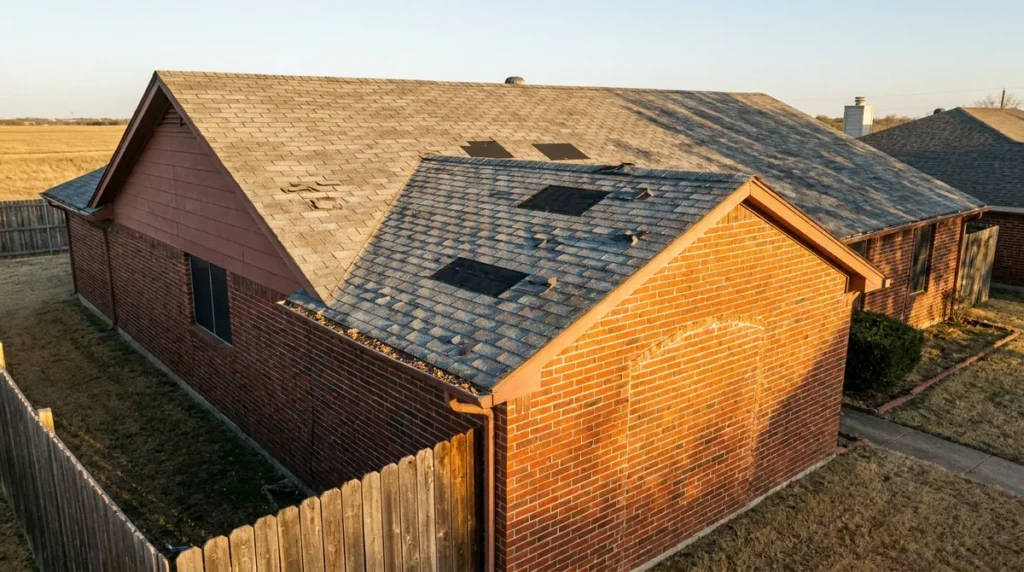
The south-facing slope had thirty-seven visible impact bruises. Not spot-obvious from twenty feet up. But circular, uniform in diameter, granule loss consistent with a one-inch to one-and-a-quarter-inch hail size — which matched the May 8 storm report for her ZIP code. The gutter aprons on the west side had matching dents at the same angle of impact. The soft metal on the AC condenser fins had a hail pattern that no salesman could have missed if he had actually walked her roof.
The upstairs ceiling stain was the third piece. It was directly under a valley on the south-facing slope. The bruise pattern had cracked the mat at one point where a nail head sat exposed under a slightly lifted shingle. Every rain since June had been drilling a tenth of a teaspoon of water into her attic insulation. By September that insulation had wicked enough moisture up into the drywall to start a stain. Left alone through October and November, it would have been a full drywall replacement by January.
The plumbing vent boot on the north slope was the fourth. Not hail related — just aged EPDM cracking. But relevant, because it was going to leak on its own timeline within two years and would either need to be part of a full-replacement scope now or a follow-up repair after the settlement was done.
The decision point on filing
Two paths were on the table. The first: file the claim within the next three weeks, document the hail damage with a proper report, meet the adjuster on the roof, and let the settlement drive a full replacement with a new class of impact-resistant shingle that would qualify her for a permanent insurance discount going forward. The second: skip the claim, pay for a spot repair on the leaking valley and the boot, live with the visible cosmetic damage on the south slope for the next four to six years until the roof was ready for a natural replacement.
The math on the first path came out around a $22,000 replacement scope, with her carrier covering roughly $19,500 after her deductible. She would pay $2,500 net for a brand-new roof with Class 4 impact-resistant shingles that would cut her homeowner’s policy premium by fifteen percent for the life of the roof. That premium reduction alone would recover her out-of-pocket in three and a half years.
The math on the second path came out around $1,600 for the spot repair, but no premium reduction, cosmetic damage staying visible on a roof she would probably sell within seven years, and a much weaker position at resale when a buyer’s inspector documented the same hail bruises she had chosen not to address. That path saved cash today and cost more later.
The pause where homeowners ask about the salesman
She asked the fair question at that point. If the solar salesman had walked her roof, how could he have missed thirty-seven bruises? The honest answer is that most door-knocker inspectors do not walk roofs in the sense a claim adjuster or a roofer means it. They look from a ladder, take a photo of the general area, and file the “inspection” as documentation for their own product pitch. They are not diagnosing damage — they are qualifying her house for a solar sale.
Most homeowners at that point ask another version of the same question. How do they know we are not doing the same thing in reverse — pushing a claim they do not need to pad a replacement job? The answer is what came home in her folder that afternoon. Photos of every bruise, a diagram tying each impact to the corresponding storm-report date, an itemized scope of what would be covered under her carrier’s typical protocol, and a written recommendation ranked by urgency. That is a diagnosis. A pitch does not look like that.
How the claim actually played out
She filed the claim two days later. Her carrier scheduled an adjuster for the following Wednesday. We met the adjuster on the roof, walked him through every bruise, showed him the ceiling stain, and matched impact locations to storm dates. The adjuster approved a full replacement scope. Settlement paid out at $19,850 minus her $2,500 deductible. Net cost to her was $2,500 for a full class-4 replacement plus the new premium discount that started on her next policy renewal.
Roof went on the following month. The upstairs ceiling stain did not spread. The drywall dried out over the winter and needed only a fresh coat of paint in the spring, not a replacement. The pipe boot got handled inside the full-replacement scope at no additional cost.
Where the story usually ends
The point of a September inspection in the McKinney corridor is not to find damage that is not there. It is to catch damage that is there but has not started leaking yet — and to catch it while the insurance claim window on the storm that caused it is still open. Every year we see one or two of these where the homeowner was three weeks from losing her claim window and did not know it because a salesman with the wrong incentive told her the roof was fine.
Not every September inspection turns into a claim. Sometimes the roof is fine. Sometimes the damage is under threshold and a homeowner is better off deferring to a natural replacement in five or seven years. What matters is that a homeowner in Frisco, Prosper, Allen, or the northern Plano corridor makes that decision with actual documentation on the table — not a driveway conversation with someone who wanted to sell her something else.
If a Collin County homeowner is deciding whether the fall is the right window for a roof inspection in McKinney, TX, the two honest questions are these. Was your ZIP code in the reported hail path of any spring or summer storm this year? Have you noticed any upstairs ceiling changes since July that were not there before? If either box is checked, the September or October walk is worth scheduling before your one-year claim window closes.
For homeowners who want to walk through what a full-inspection deliverable actually looks like, our roof inspection page covers the report format, and our hail damage roof repair page walks through the scope that gets built when documentation is done properly. If the September walk turns up something urgent, our storm damage roof repair page covers the emergency response side.
For a fuller picture of how a specific Collin County storm actually plays out on local roofs, our post on what the April 2026 Allen storm actually did to local roofs covers the first-forty-eight-hours timeline in detail.
