
Was It Hail or Just Summer Heat Behind This Roof Repair in Frisco, TX?
The situations described here are composites drawn from the types of jobs and decisions we encounter regularly. Names and specific figures are illustrative.
The call came on a Tuesday in mid-October, the morning after the first real rain Frisco had seen in weeks. A homeowner in Phillips Creek Ranch had found a brown ring on her upstairs bathroom ceiling, around the exhaust fan. Half her street had put on new roofs after an April hailstorm, and her theory was simple: the hail got her roof too, the rain proved it, and she needed roof repair in Frisco, TX plus an insurance claim. Her house was built in 2012 and still had its original shingles. She wanted someone to confirm that before she called her carrier.
We were out that afternoon. Her theory turned out to be half right, and the half that was wrong mattered more than she expected.
First Fall Rain Finds Problems
A North Texas roof spends most of the summer dry and hot. The National Weather Service office in Fort Worth puts the average first 100-degree day at DFW on July 1 and the average last one on August 27, and some years run far past that. In 2011, DFW recorded 71 days at or above 100 degrees. Shingle surfaces on a sunny slope get a lot hotter than the air around them, and the rubber and plastic parts of a roof take that heat every afternoon for weeks.
Most of that damage stays quiet while it is dry. A crack in a pipe boot or a shingle that has curled at the edge does nothing in August. Then a fall front comes through Collin and Denton counties with a slow, all-day rain, and every weak spot on the roof gets tested at once. That is why our phone tends to ring in October with leaks that homeowners assume are brand new.
Frisco adds its own twist. A lot of the housing stock in neighborhoods like Phillips Creek Ranch, Richwoods, and Starwood went up in the same ten-year window, which means a lot of roofs reaching the same age with the same original components at the same time. When one house on a street has a problem, the house next door often has the same one waiting.
What the Attic and the Roof Showed
We started in the attic, because a ceiling stain only tells you where the water ended up. The decking above the bathroom was dry. The water trail ran along the outside of a plumbing vent pipe about four feet from the fan, then dripped off a joint onto the drywall. That pointed straight up at the pipe boot.
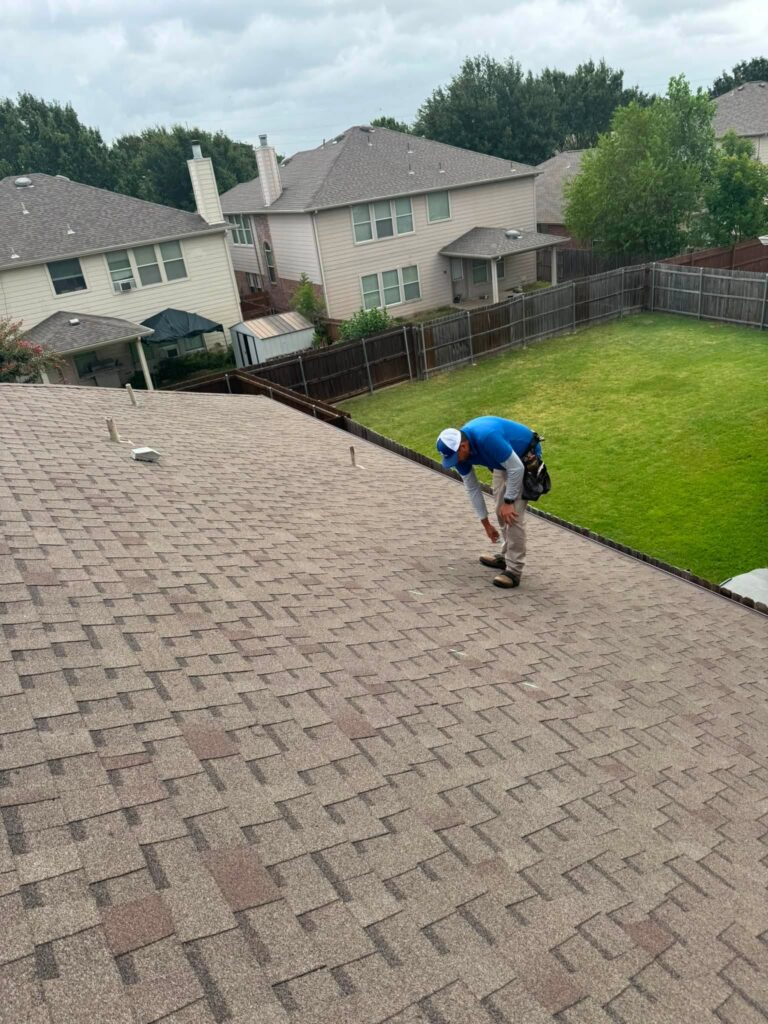
On the roof, the rubber collar around that vent pipe had split along the top edge, the side facing the afternoon sun. Water running down the slope was getting under it and following the pipe into the attic. The other two pipe boots on the same slope had the same kind of surface cracking, just not all the way through yet. None of that had anything to do with hail.
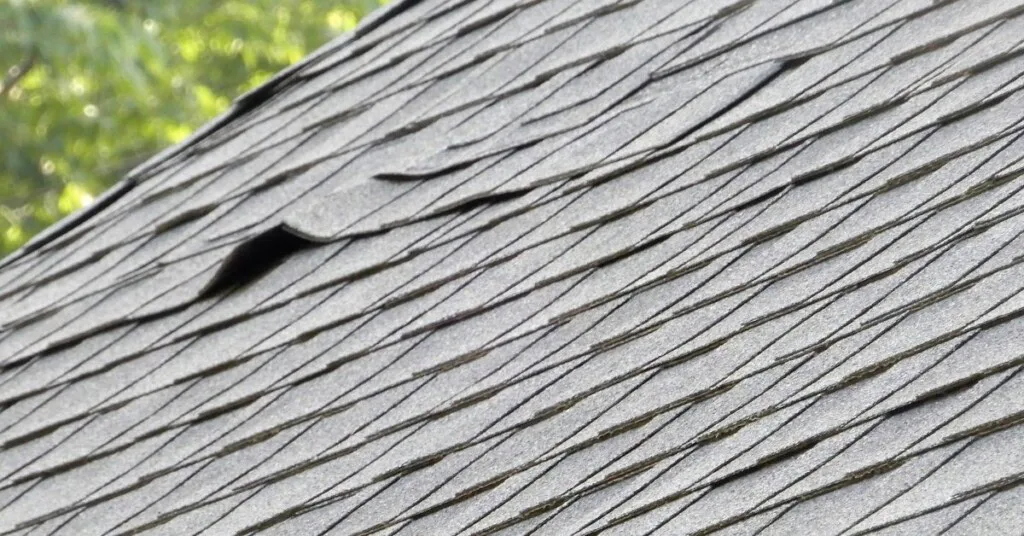
The west slope near the ridge had a patch of shingles with lifted, curled edges, similar to what is shown above. That pattern lines up with years of afternoon sun and a sealant strip that has let go. Again, not hail.
The hail damage was on the north and east slopes. There were soft dents across the metal vent caps, spatter marks on the gutters, and scattered spots on the shingles where granules had been knocked loose and the mat underneath felt soft when pressed. That matched the April storm the neighbors had already been paid for. It had not caused the leak, and it was not obvious from the yard.
Here is how the findings sorted out when we laid them out for her.
| What we found | Most likely cause | How it usually gets handled |
|---|---|---|
| Split pipe boot over the bathroom (the leak) | Years of sun and heat on the rubber collar | Maintenance repair, paid out of pocket |
| Two more pipe boots with surface cracking | Same age and exposure | Replace during the same visit |
| Curled, unsealed shingles near the west ridge | Heat and age | Hand-seal or replace a small section |
| Bruised shingles, dented vent caps and gutters on the north and east slopes | April hailstorm | Document with dates and photos; insurance claim |
The Assumption That Almost Muddied the Claim
Her plan had been to call the insurance company and say the April hail caused a leak. That is a common instinct, and it can work against the homeowner. An adjuster who climbs up, follows the water trail, and finds a sun-cracked pipe boot is going to write that down as wear and tear. Once the leak is tied to maintenance in the file, the conversation about the hail damage on the other slopes starts on the wrong foot.
The heat and the hail are not completely separate stories, though. Research from the Insurance Institute for Business & Home Safety found that repeated small hail knocks granules off asphalt shingles, which exposes the asphalt to sunlight and speeds up aging, and that shingles hit by small hail and then weathered became far more vulnerable to later large hail. On a Frisco roof, a spring of hail followed by a summer of triple-digit heat compounds. That is part of why the north and east slopes looked older than the rest of the roof.
What we told her was to keep the two problems apart. Fix the leak now as the repair it was. Then report the hail damage as hail damage, with the storm date, photos, and the specific slopes where it showed up.
The Decision on Her Kitchen Counter
The Texas Department of Insurance advises homeowners with wind and hail coverage to file a claim quickly, take photos and video, and prevent further damage while they wait, keeping receipts for temporary repairs. Her policy’s “duties after loss” section asked for prompt notice too, and the April storm was already six months back. That was the part that made her sit down. Every policy words its notice requirement a little differently, so we suggested she read hers and call her agent the same day rather than take anyone’s general rule for it, including ours.
Once a claim is reported, Chapter 542 of the Texas Insurance Code sets the pace for the insurer. In general, the company has 15 days to acknowledge the claim, start its investigation, and ask for what it needs, and then 15 business days after it receives those items to accept or reject the claim in writing. Knowing that clock helped her plan the next month.
Here is how the timeline actually played out.
| When | What happened |
|---|---|
| April | Hailstorm crosses her part of Frisco; no visible damage from the yard |
| July to August | Weeks of triple-digit afternoons; pipe boot splits on the sun-facing side |
| Mid-October, day 1 | First steady rain; ceiling stain appears; inspection the same afternoon |
| Day 2 | Pipe boots replaced, west ridge resealed; hail claim reported with photos |
| About two weeks later | Adjuster inspection with our crew on the roof |
The leak repair through our roof repair service took a couple of hours: three new pipe boots and the west ridge shingles hand-sealed. It cost a few hundred dollars, which she paid herself. Her deductible on the policy was several times that, so filing the leak would not have made sense even if it had been covered.
What the Adjuster Approved, and What It Left Her With
The adjuster agreed the north and east slopes had hail damage and approved replacing those two slopes. The south and west slopes were written up as age-related wear. That is a common outcome, and it put her at the real decision point.
She could patch in two new slopes next to two 14-year-old ones and pay only her deductible. Or she could pay the difference to replace the whole roof at once. Patching meant mismatched shingle color and two old slopes that would need replacing in a few years anyway, with a second round of tear-off, permits, and crew time. A full replacement meant writing a bigger check now.
She chose to pay the difference and move to a Class 4 impact-rated shingle across the whole roof. The Texas Department of Insurance explains that roofing tested for impact resistance is classified from Class 1 to Class 4, that Class 4 earns the largest premium credit, and that each insurance company sets its own discount amount and paperwork. She called her agent to confirm what her carrier would accept before she signed anything. Spending more than that, on upgrades the insurer would not recognize and the house did not need, would have stopped making sense for her budget.
The install went on in early November. Fall is a good window for this kind of work in Frisco. The afternoons are mild, the spring storm backlog is long gone, and crews are not stretched across dozens of hail jobs at once.
What Homeowners Usually Ask at This Point
The questions she asked are the same ones we hear on most October calls across Frisco and the rest of Collin County.
She asked whether it was too late to file for a storm from April. Our honest answer was that it depends on her policy, not on us. Texas law sets deadlines for how the insurer responds once a claim is filed, but the notice requirement for the homeowner lives in the policy itself. Reading that section and calling the agent is the fastest way to know where she stood.
She asked how she could have spotted the hail damage herself. In most cases, she could not have from the ground. Dented vent caps and gutter spatter are sometimes visible with binoculars, but bruised shingles usually are not. A roof inspection with dated photos after any notable storm gives a homeowner a record to work from later.
She asked whether a roofer could just cover her deductible to make the full replacement cheaper. We do not do that, and the Texas Department of Insurance points out that it is illegal in Texas for a contractor to offer to waive, rebate, or absorb a policyholder’s deductible. We wrote about that situation in a post on a McKinney homeowner offered a free deductible after hail.
And she asked whether the heat would just crack the new pipe boots again. Eventually it will, though better boots and good attic ventilation slow it down. Attic heat plays a part in how fast shingles age from underneath, which we saw firsthand in a Wylie attic that hit 152 degrees in June.
What We Took Away From This One
As firefighters, the owners of Fireman’s Roofing learned early that the place where you see the damage is rarely where it started. Smoke shows up in one room, and the fire is two walls over. A ceiling stain works the same way. The October leak on this house came from summer heat, and the hail damage that actually justified a claim was sitting quietly on slopes that never leaked at all.
Not every Frisco roof that leaks in the fall has hail damage hiding on it, and not every hail claim ends in a full replacement. Sometimes a few hundred dollars of pipe boots is the whole story. Our Frisco roofing services page covers how we approach inspections and repairs in neighborhoods like this one, where a lot of roofs are reaching the same age together.
If the first fall rain has turned up a stain and you are weighing roof repair in Frisco, TX against a possible hail claim, the useful first step is figuring out which damage came from which season. If you’re looking for hail damage roof repair in Frisco, you can reach out here.
Sources
- DFW 100-Degree Day Summary, National Weather Service Fort Worth/Dallas
- Impact Testing of High Concentrations of Small Hail, Insurance Institute for Business & Home Safety
- Hail Damage? Tips to File an Insurance Claim, Texas Department of Insurance
- Texas Insurance Code, Chapter 542: Processing and Settlement of Claims
- Roofing Discounts (Impact-Resistant Roofing), Texas Department of Insurance
- Roofing and Insurance: Know the Law, Texas Department of Insurance
